Infant feeding

Breastfeeding can help improve the lifelong health and emotional development of your child.

Exclusive breastfeeding (giving your baby breast milk only) is recommended for around the first six months of your baby’s life. After that, giving your baby breast milk alongside other food will help them continue to grow and develop, as well as reducing their risk of illness.

We aim to provide encouragement, support and up to date information to enable you to breastfeed your baby confidently and successfully. If you choose to bottle feed your baby we aim to support you to do so as safely as possible.

To help you decide how you would like to feed your baby Unicef’s baby friendly initiative resources provide information and advice on caring for babies and families which also includes advice on hand expressing. You can also find support from:

Breastfeeding support

Many mums find support with breastfeeding helpful. This can be at any time, from pregnancy and getting started, to your child’s final breastfeeds.

  • Mastitis information from the Breastfeeding Network
  • The Association of Breastfeeding Mothers has information on how lactation works and a video, More than milk explains how breastfeeding can provide your baby with cuddles, comfort, connection, calming and calories.

NHS Kent and Medway’s BesideYou website is full of helpful information and support for breastfeeding mothers.

Talk to your midwife or health visitor

Midwives and health visitors across the community and in our hospitals are trained to share information and support you with feeding your baby. You can ask them questions at any point during your pregnancy and following birth.

Peer support

One of our breastfeeding peer supporters may visit you at the hospital after your baby is born, you will recognise them by their t-shirts or tabards. Breastfeeding peer supporters are mums who have breastfed and have been trained to help other mums.

They can answer any questions you might have, tell you about local breastfeeding services and support you in your breastfeeding journey. Ask the midwives at the hospital or birth centre for a consent form before you go home if you would like to receive a call.

Breastfeeding support in Kent

Kent infant feeding support sessions [pdf] 7MB are free to attend and you can access them regardless of where you live. The sessions are run by lactation consultants, breastfeeding counsellors or breastfeeding peer supporters. They are an opportunity to meet other mums and get information and support with breastfeeding.

You don’t need to book (except at Woodlands Children’s Centre where you can book a one-to-one appointment with a lactation consultant) just turn up to a session that suits you.

For up to date Kent breastfeeding drop-ins, peer support groups and child health clinics, visit www.kentcht.nhs.uk/kentbaby.

You can also find details of your local child health clinic and if they offer breastfeeding support.

These sessions are run by health visitors and nursery nurses with peer support volunteers. You can visit them before birth for information on infant feeding and postnatally for infant feeding support.

For up to date information of community-based support groups and to find out about groups in Kent, visit Kent Baby Matters.

Breastfeeding support in East Sussex

The Sussex infant feeding support sessions [pdf] 416KB are delivered by mums who have breastfed and trained as volunteers to offer feeding support to families, before and after they give birth.

If you would like to chat with a peer support volunteer or would like to meet others who are breastfeeding too, you can find them at many groups and clinics.

Unicef Baby Friendly Initiative (BFI)

We are working towards Unicef Baby Friendly Accreditation. The BFI standards enable our staff to:

  • Support pregnant women to recognise the importance of breastfeeding and early relationships for the health and wellbeing of their baby
  • Support all mothers and babies to initiate a close relationship and feeding soon after birth
  • Enable mothers to get breastfeeding off to a good start
  • Support mothers to make informed decisions and receive support when feeding their baby formula milk
  • Support parents to have a close and loving relationship with their baby and know why this is important.

Crowborough Newborn Cafe

The newborn café at Crowborough Birthing Centre is a friendly, free to attend drop-in support group, held every Thursday 9am-12pm (last entry at 11.30am), The Day Centre, Crowborough War Memorial Hospital, Southview Close, Crowborough, TN6 1HB

Join us for a cup of tea and expert one-to one infant feeding support for babies up to 12 weeks old. Older children are also welcome.

Please check the Crowborough Birthing Centre Instagram page before visiting in case of cancellations.

Maidstone Newborn Cafe

The newborn café at Maidstone Birth Centre is a friendly, free to attend drop-in support group held every Tuesday 9.30am-11.30pm (last entry at 11am) at Maidstone Birth Centre, Hermitage Lane (behind Maidstone Hospital), Maidstone ME16 9QQ

Join us for a cup of tea and expert one-to one infant feeding support for babies up to 12 weeks old. Older children are also welcome.

Please check the Maidstone Birth Centre Instagram page before visiting in case of cancellations.

Hand expressing/antenatal colostrum collection

Antenatal hand expressing is advisable for all women planning to breast feed but is especially useful if you have gestational diabetes or know that your baby is likely to be born early or require special care at birth.

If you are planning to breastfeed your baby or give your baby expressed breast milk you can start trying to hand express before your baby arrives, any time after 36 weeks. If you are expecting twins you can start expressing at 32 weeks.

If you are able to express colostrum (early milk) you can store it and give it to your baby when they are born. Some babies are quite sleepy for the first day after birth and if you know how to hand express, and have practiced the technique, you will be able to hand express colostrum directly onto baby’s lips on the first day until your baby wakes up and is ready to feed. Ask your community midwife for some syringes to store your expressed breast milk or use a sterilised container.

Remember you will only be collecting very small volumes of colostrum. The colostrum collecting clinic runs on Mondays evenings at 5.30pm.

Watch our hand expressing video or visit our infant feeding page.

Who benefits from antenatal colostrum collection?

A mother who has:

  • Diabetes, including gestational diabetes
  • A raised BMI (35 or above)
  • A multiple pregnancy (twins or triplets)
  • A breast abnormality or previous breast surgery
  • Taken certain medication during pregnancy and treatment for high blood pressure (for other medications your midwife or doctor will advise)
  • Found breastfeeding challenging previously.

If baby is:

  • At risk of prematurity (being born before 37 weeks of pregnancy)
  • At risk of being small for gestational age
  • Diagnosed antenatally with cleft lip or palate
  • Diagnosed antenatally with chromosomal disorder (such as Down’s Syndrome).


Freshly expressed colostrum can be stored in:

Where Use before
Room 6 hours
Fridge (5*C – 10*C) 3 days
Fridge (0*C – 4*C) 8 days
Freezer (-18*C or lower) 6 months

Frozen colostrum can be

  • Used immediately if defrosted at room temperature
  • kept for up to 12 hours if defrosted in the fridge.

Top tips for expressing colostrum

  • Pressure should always be backwards, towards chest wall and pain free throughout
  • Do not slide fingers forward during compression.
  • Fingers can be moved around your nipple (remember they should remain 2-3cm away from the base of the nipple)
  • A maximum of 10 mins expressing from each breast up to 3 times a day is sufficient
  • Alternate expressing from each breast

Colostrum may be slow to appear, just be patient and relaxed! It can take several attempts.

Tongue tie service

We provide a tongue tie division service. If you are having problems with breastfeeding please let your midwife know and they will check your baby’s mouth for the presence of tongue tie.

They will help you initially with positioning and attaching baby at the breast as not all tongue ties need to be divided.

You cannot self-refer to the tongue tie clinic but can be referred by your midwife, health visitor, GP or lactation consultant.

It is important you get help with positioning and attaching baby, expressing milk to keep your supply up and feeding your baby expressed milk while waiting for an appointment. Your midwife will help you with this or you can come to a specialist drop-in clinic for advice.

Bottle feeding

The First Steps Nutrition Trust website has useful information if you are thinking of bottle feeding your baby.

If you decide to bottle feed your baby you must bring in your own formula and bottles to use in hospital – we are unable to provide this for you.

For convenience you may want to use ready made, artificial milk but we will show you how to make up a bottle using powdered artificial milk before you go home, please ensure the staff do this.

For more information on using formula, sterilising and making up bottles is on the NHS website, and there is helpful advice on the NHS Best Start in Life website.

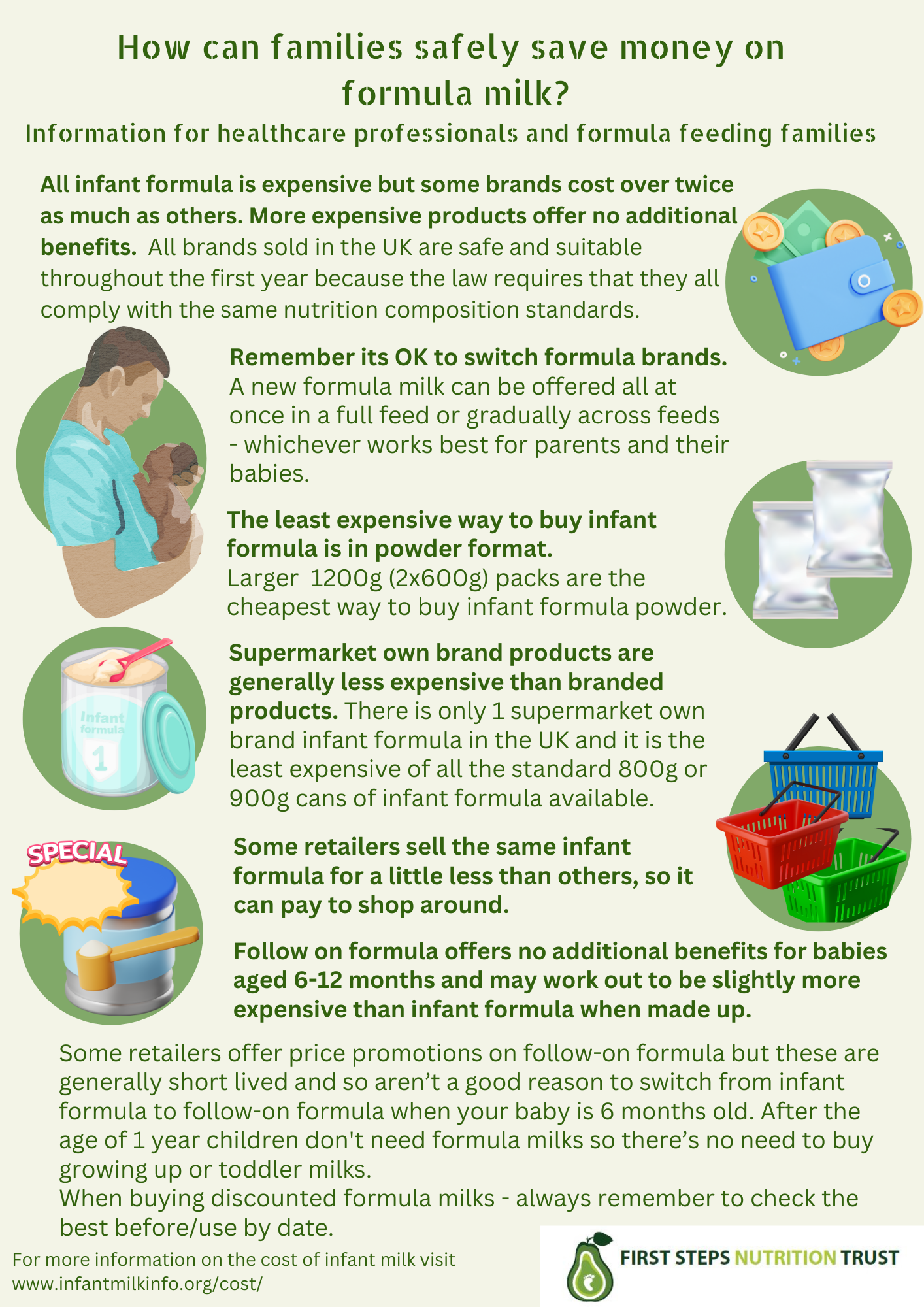
The First Steps Nutrition Trust also has information on how to safely save money on formula.

Virtual breastfeeding information sessions

Our Infant Feeding team run regular virtual breastfeeding information sessions.

Discussions include:

  •  expectations around infant feeding
  • the changes in the body during pregnancy
  • skin to skin and the first feed
  • how to position and attach baby for a deep latch
  • normal new-born night-time feeding and sleep
  • hand-expressing
  • troubleshooting common problems
  • responsive breastfeeding
  • responsive parenting.

You can attended this session anytime during your pregnancy. There are a limited number of tickets available as we like to have a small discussion group.

We recommend birth partners attend as they will be your advocates and supporters after the baby is born.

Visit our MTW Maternity Facebook page for dates.

If you have any questions contact the Infant Feeding team at mtw-tr.infant-feeding-specialists@nhs.net